(Blue Bottle in my kitchen window) Writers and poets in the far western mountain area of North Carolina and bordering counties of South Carolina, Georgia and Tennessee post announcements, original work and articles on the craft of writing.
Friday, June 4, 2010
STUDENT POET OF THE DAY:LIA WALDRUM
(Blue Bottle in my kitchen window) Thursday, June 3, 2010
CONVERSATIONS: William Everett
I'm trying a new feature on the blog today, one tentatively called Conversations, in which a writer's offering is posted for comments and responses. These need not be "critiques," as such, though I think most writers would welcome intelligent suggestions. Rather, this is to be a way for authors here in the mountains and elsewhere to engage each other in lively discussions of their work. The first feature is a poem by William Everett, novelist, essayist, scholar and poet. His website is www.williameverett.com. PLEASE LEAVE YOUR COMMENTS. LET'S SEE IF WE CAN GET A CONVERSATION GOING ACROSS THESE RIDGES!
She is ready,
purse packed,
hands pocketed in resolution,
standing by her charge.
Will she fly through puffball clouds,
piercing azure heavens like a needle?
Or will she cruise majestically across the land,
blowing tumbleweeds and sagebrush in her wake?
Perhaps the sea shall feel the power of her legs,
the undulations of her mermaid form.
For she is ready,
her glowing hair pinned sleekly back,
the keys clutched in her hand.
She is the girl with the ’55 Plymouth fins.
---William Everett
Wednesday, June 2, 2010
COFFEE WITH THE POETS AT CITY LIGHTS, FEATURING GLENDA BEALL

COFFEE WITH THE POETS AT CITY LIGHTS, FEATURING GLENDA BEALL
City Lights Bookstore is pleased to announce a program for readers and writers
on the third Thursday of each month, beginning June 17. Coffee with the Poets
will feature a guest poet each month, including an informal discussion and
reading. The program will begin at 10:30, with coffee and snacks provided.
Spring Street Cafe welcomes all attendees to come downstairs for lunch
afterward.
The inaugural event will feature Glenda Council Beall of Hayesville. Glenda
has published poetry, personal essays, memoir, and fiction, and she is former
Program Coordinator for the North Carolina Writers’ Network West (NetWest).
Her background is in education and she continues to teach adults through
community services at Tri-County Community College and at the John C.
Campbell Folk School in Brasstown.
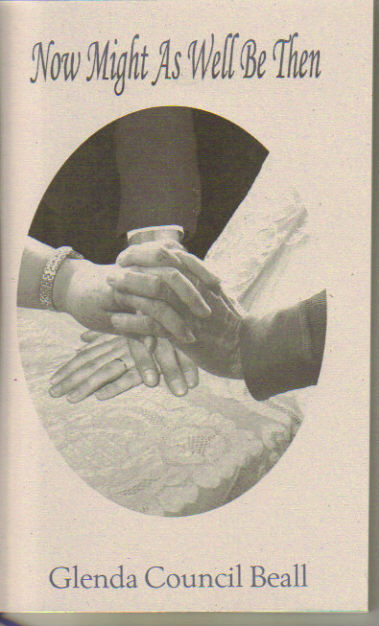
Glenda's book of poetry, Now Might as Well be Then, was recently published by
Finishing Line Press. Her blog, Writing Life Stories, at
http://profilesandpedigrees.blogspot.com shares some of her own stories and
suggestions for writing your own.
City Lights Bookstore
828-586-9499
3 East Jackson Street
Sylva, NC 28779
more@citylightsnc.com
Open 9 a.m. to 9 p.m. Monday-Saturday, and 10 a.m. to 3 p.m. Sundays
Browse and shop online at http://www.citylightsnc.com
Glenda Council Beall's new chapbook, Now Might As Well Be Then, from Finishing Line Press (http://www.finishinglinepress.com/) deserves many readers. I was honored to write a blurb for it. Glenda has worked wonders for NETWEST as Program Director and deserves our thanks for supporting the literary arts in Western North Carolina. Her new book would make a wonderful Christmas gift for family members. Several in my family will have this chapbook in their stockings!
Often those "supporters" are so busy making sure other writers find what they need to become better at the writer's craft that they don't have time for their own work. That's why I'm so pleased to honor Glenda as Poet of the Week. She's a great SW Georgia girl, and, naturally, I believe those girls have a leg up when it comes to writing poetry!
Here are a few of my favorite poems from her new chapbook.
Woman in the Mirror
What happened to seventeen,
when I rode my mare
free as the river flows,
jumped over downed trees
splashed through narrow streams?
What happened to twenty
when I danced in the moonlight,
my slender form dressed in a gown
white and shimmery as pearl?
What happened to thirty
when I rode my Yamaha
down fire roads, mountain trails,
long black hair flying free?
What happened to those days
I ask the woman in the mirror.
Gone, she says, all gone, unless
you remember it.
In The Dark
Lying in bed, my cheek against your shoulder,
I remember a night, long ago, on your boat.
I was afraid. I felt too much, too fast.
But love crept over us that summer
like silver fog, silent on the lake.
We were never again the same.
We stepped like children through that door that led
to long passages unknown, holding hands, wide-eyed, but brave.
Here I am years later, listening to your soft breath
and feeling your warm smooth skin.
In the dark, now might as well be then.
My Father's Horse
Stickers tear my legs, bare and tan
from South Georgia sun. Long black braids
fly behind me as I sprint like a Derby winner
down the path.
Harnessed with hames, bridle
and blinders, Charlie plods down
the farm road. Tired and wet from sweat,
he is perfume to my nostrils.
My father swings me up. I bury
my hands in tangled mane. My thighs
stick to leather and damp white hair
high above the ground.
I want to sing in glorious joy,
but only croon a child's nonsensical
words, grinning for a hundred yards
between field and barn.
My father's arms are strong.
His hands are gentle. The horse
is all we ever share. For he has sons
and I am just a daughter.
A Long Lost Year
Music making was his talent
taken for granted like water
gushing from our well until
the surgeon’s knife nicked a nerve.
The purple wreath of grief hung
over us until one day above the strum
of his guitar, his notes rang true ?
a lovely instrument restored.
We wept with joy.
His voice is who he is,
has
always been.
He sings to me again, that same
rich baritone that won me on that first
day we met. I listen with a new ear,
and like a Sinatra fan,
I mellow out.
Summer Writing Residency ARE YOU INTERESTED?
>From July 23–25, the North Carolina Writers’ Network will offer the 2010 Squire Summer Writing Residency, a full weekend of intensive workshops at Peace College in downtown Raleigh. The Residency is an intimate, affordable alternative to large conferences, and a rare opportunity to create bonds within the writing community.
Sam Ragan Award-winner David Rigsbee, a prolific and erudite NC poet and professor who has been mentored by such luminaries as Carolyn Kizer and U.S. poet laureate Joseph Brodsky, will work with poetry registrants on the problems of “Passion and Restraint in the First-Person Poem,” using examples of persona, authenticity, form, and authority from contemporary poets. This workshop gives registrants the time and focus to pay attention to the details in their work and to stay concrete and clear with language.
Past attendees have said the following about the Residency:
"The entire group brought a sense of community to my writing that I hadn't had before."—Ivy Rutledge
"I found an open, welcoming community of people who immediately accept anyone who has a desire to write."—Karen Price
More information about the Squire Summer Writing Residency can be found at www.ncwriters.org or by calling 336-293-8844.
--
Virginia Freedman
Administrative Director, NC Writers' Network
PO Box 954, Carrboro, NC 27510
(919) 251-9140
Tuesday, June 1, 2010
Student Poet of the Day: Abrianna Berry
Last fall the Great Smoky Mountains Bookfair sponsored a Poetry Contest for K-12 students in Macon, Haywood, Jackson, and Swain Counties. The winners were posted on my NC Laureate blog in November. Going through the rest of the poems submitted, I was struck by how many were just plain good, worthy of being enjoyed by readers of this blog. For the next two weeks I will be featuring one of these young poets daily. Each one will receive a small "thank you" from me. Please stop by everyday to read their work.
WRITERS' NIGHT OUT TO FEATURE KAREN HOLMES

HIAWASSEE – June 1, 2010 – Come hear authors reading their work at the new monthly event, Writers’ Night Out at Mountain Perk Coffee House in Hiawassee, GA. This month, Karen Paul Holmes of Hiawassee/Atlanta will read her poetry on June 11 at 7:00 p.m. Her reading will be followed by an Open Microphone for those who’d like to share their own poetry or fiction. These light literary and musical evenings take place on the second Friday of every month from 7 p.m. to 8:30 p.m. Please arrive early as the event has drawn a full house in its first two months.
Karen Paul Holmes is an award-winning business writer who began focusing on poetry after moving to the Blue Ridge Mountains. Her publishing credits include journals such as Poetry East, Atlanta Review and Sow’s Ear Poetry Review and anthologies, including the upcoming Echoes Across the Blue Ridge: Stories, Essays & Poems Written by Writers Living in & Inspired by the Southern Appalachian Mountains. Karen enjoys reading her poetry in public, classical music, Ikebana and contra-dancing. She’ll be teaching a writing class at John C Campbell Folk School next January.
Wednesday, May 5, 2010
Rosemary Royston, poet, will read on May 12 at Mountain Perk

Monday, May 3, 2010
Scott Owens to Visit Far Western NC and North Georgia

By Glenda C. Beall
I recently interviewed Scott Owens, well-published and highly acclaimed poet from Hickory, NC. In his book The Fractured World, Scott explores his childhood in which he suffered physical and emotional abuse and the impact this had on his life.
He says of this book, “I have found it very cathartic to write about the darker parts of my life, as you put it. I have used poetry for a long time as a sort of self-therapy, but I have also known that writing about these things was one way to help others who had been through similar experiences to know that they were not alone, and to help those guilty of the negative actions and attitudes portrayed in the book to understand that it's not okay, that what they do causes a lifetime of irreparable harm.”
In his book, Paternity, he writes about his relationship with his little daughter Sawyer.
“Sawyer is my only biological child. I have two stepsons who are both in college now, and I had a stepson with a previous wife for a few years as well.
The first new poem in this book was an occasional poem written for the Jewish ceremony of naming the new baby. The next one was written after holding her one night and crying as I realized the clichés about being willing to die for someone were not just clichés.”
He went on to say, “A lot of my poems are attempts to convey the emotional intensity of a particular moment. In a larger sense, I think I wanted to continue with these poems to finish what I had started in The Fractured World. That book ends with the disintegration of Norman, my alter ego who represents the fear and alienation that result from child abuse.
Scott grew up part of the time on his Papa's 7-acre farm, part of the time in various mill villages in a nearby small town, part of the time in trailer parks around military bases, and part of the time in military housing. His parents were married and divorced numerous times, including three times to each other.
“If I include all of my stepbrothers and sisters, then my family size would rival the Duggars, but most of the time my family was my mom, myself, my three brothers, and whatever "Daddy" happened to be around at the time,” Scott said.
I asked him how his childhood affected his writing as an adult and he said, “I suspect my writing is what allowed me to become an adult, both literally and figuratively. Life has not been great for my three brothers. They have all struggled to maintain sanity and security in their lives. On the other hand, I graduated, went to college, became a teacher, and pretty much stayed out of trouble. And the only real difference between me and them is that I read and started writing at a young age and frequently went to books when I needed to get away from a difficult reality. I would say my childhood gave me the motivation and the reason to write. I see my writing as my way of redeeming that childhood.
“Your poetry is accessible and can be understood by the average reader. Do you think our modern poets, like you, are bringing poetry back to the people?" I asked the poet.
" … I think with the proliferation of poetry readings there is a growing tendency to be a bit more accessible than a lot of poetry had been for the last 25 years or so. Personally, I don't see the attraction in being needlessly obscure. I have plenty of difficult poems, but I hope that even with the most difficult the poem achieves some level of emotional or intellectual effect upon a good reader.”
I asked Scott Owens to tell us why we should come to hear him read his poetry at Coffee With the Poets, Wednesday, May 12 at 10:30 a.m. and at Mountain Perk in Hiawassee, GA that evening at 7:00 p.m. I like his answer.
A big part of that connectedness, as you've alluded to in your questions, is the connectedness of one human life to another. This is what allows us to achieve catharsis by watching, listening to, or reading about someone else's experience. We recognize our own story in theirs and are able to learn from it. Then, of course, there is the best reason of all, because it will be fun.”
Phillips and Lloyd Books hosts a book signing for Scott from noon until 1:00 p.m. right after Coffee with the Poets on May 12.
Curiosity Shop Books in Murphy, NC will host Scott for a book signing at 2:00 p.m. May 12.
Stop in to meet him and pick up one of his books.
Contact Glenda at glendabeall@msn.com or 828-389-4441 for more information.
Saturday, May 1, 2010
POETS OF THE DAY: SIX POETS FROM THE MOUNTAIN SOUTH

SIX POETS FROM THE MOUNTAIN SOUTH was recently published by LSU Press. As my last Poet of the Day feature, I'm including three poets from that volume--Jim Wayne Miller, Jeff Daniel Marion, and Fred Chappell. The LSU catalog copy appears below.
In the most extensive work to date on major poets from the mountain South, John Lang takes as his point of departure an oft-quoted remark by Jim Wayne Miller: “Appalachian literature is—and has always been—as decidedly worldly, secular, and profane in its outlook as the [region’s] traditional religion appears to be spiritual and otherworldly.” Although this statement may be accurate for Miller’s own poetry and fiction, Lang maintains that it does not do justice to the pervasive religious and spiritual concerns of many of the mountain South’s finest writers, including the five other leading poets whose work he analyzes along with Miller’s.
Fred Chappell, Robert Morgan, Jeff Daniel Marion, Kathryn Stripling Byer, and Charles Wright, Lang demonstrates, all write poetry that explores, sometimes with widely varying results, what they see as the undeniable presence of the divine within the temporal world. Like Blake and Emerson before them, these poets find the supernatural within nature rather than beyond it. They all exhibit a love of place in their poems, a strong sense of connection to nature and the land, especially the mountains. Yet while their affirmation of the world before them suggests a resistance to the otherworldliness that Miller points to, their poetry is nonetheless permeated with spiritual questing.
Dante strongly influences both Chappell and Wright, though the latter eventually resigns himself to being simply “a God-fearing agnostic,” whereas Chappell follows Dante in celebrating “the love that moves the sun and other stars.” Byer, probably the least orthodox of these poets, chooses to lay up treasures on earth, rejecting the transcendent in favor of a Native American spirituality of immanence, while Morgan and Marion find in nature what Marion calls a “vocabulary of wonders” akin to Emerson’s conviction that nature is the language of the spiritual.
Employing close readings of the poets’ work and relating it to British and American Romanticism as well as contemporary eco-theology and eco-criticism, Lang’s book is the most ambitious and searching foray yet into the worlds of these renowned post–World War II Appalachian poets.
John Lang, professor of English at Emory & Henry College in Emory, Virginia, is the author of Understanding Fred Chappell and editor of Appalachia and Beyond: Conversations with Writers from the Mountain South.

(Jim Wayne Miller)
At 9:42 on this May morning
the children's rooms are concentrating too.
Like a tendril growing toward the sun, Ruth
moves her book into a wedge of light
that settles on the floor like a butterfly.
She turns a page.
Fred is immersed in magic, cool
as a Black Angus belly-deep in a farm pond.
The only sounds: pages turning softly.
This is the quietness
of bottomland where you can hear only the young corn
growing, where a little breeze stirs the blades
and then breathes in again.
I mark my place.
I listen like a farmer in the rows.
from The Mountains Have Come Closer, 1980 ©
Reunion
Last night in a dream
you came to me. We were young
again and you were smiling,
happy in the way a sparrow in spring
hops from branch to branch.
I took you in my arms
and swung you about, so carefree
was my youth.
What can I say?
That time wears away, draws its lines
on every feature? That we wake
to dark skies whose only answer
is rain, cold as the years
that stretch behind us, blurring
this window far from you.
from Ebbing and Flowing Springs
FRED CHAPPELL
Spotlight
Only the page of numerate thought toils through
The darkness, shines on the table where, askew
And calm, the scholar's lamp burns bright and scars
The silence, sending through the slot, the bars
And angles of his window square, a true
Clean ray, a shaft of patient light, its purview
Lonely and remote as the glow of Mars.
from Shadow Box, LSU Press
Friday, April 30, 2010
POET OF THE DAY: MARY ADAMS


My friend Mary Adams is such a good poet that words fail me. But they never seem to fail her.
Commandment
By Mary Adams
When we were lonely
Love doubly
blessed us. Earth
filled us. Birth
welled like morning,
clean yearning
poured over the void
and we said
nothing could quiet this
urge, this riot, this
self-forgetfulness.
And then the doe
so wild going so
still, saw the brink
of wilderness sink
in our plenty, our
pity. Oceans for
which we longed dried
and our best laid
the world waste:
it wasn’t just
never enough love
that Jesus suffocated of.
TIME CATS
-- after Mr. Lloyd Alexander, 1924-2007
To console you for growing old, I got you a gift
to take you out of time. Not poems, which are always
ending after they start. And not knitting,
which if worn you might wear out. The best
gifts are light, but not too light, and flow
everywhere, like the ache of debt. This year
your gift should signify the infinite.
So I got you kittens, tricked by your own fingers
from the wild. Because they compound eternally,
but warmer. Because a single box contains
all kittens till it’s opened. Because a kitten
mewing makes a butterfly make a tornado.
Because a knotting of kittens extends in a plane
forever. Because a dying kitten is
impossibly light, and a lost kitten’s cry
is bottomless. And since each kitten wells
with the cat of danger, we know every cat
wears kittens like an urge. None is ever
really lost. Then cats point both ways always.
Now you are grown, here are all your kittens,
new again, like money you found in the laundry.
Heft them gently. Feel in their small hearts
your trembling. Calm them in the morning
of your fears. When you are sad, speak
them like cadences, kitten of cross-fire,
kitten of backflip, kitten of glory, kitten of
clutching, kitten of pestering and plummet, spindly
kitten, hungry kitten, kitten of solace.
POET OF THE DAY: GLENDA COUNCIL BEALL
Glenda Council Beall's new chapbook, Now Might As Well Be Then, from Finishing Line Press (http://www.finishinglinepress.com/) deserves many readers. I was honored to write a blurb for it. Glenda has worked wonders for NETWEST as Program Director and deserves our thanks for supporting the literary arts in Western North Carolina.
Here are a couple of my favorite poems from her new chapbook. WOMAN IN THE MIRROR
What happened to seventeen,
when I rode my mare
free as the river flows,
jumped over downed trees
splashed through narrow streams?
What happened to twenty
when I danced in the moonlight,
my slender form dressed in a gown
white and shimmery as pearl?
What happened to thirty
when I rode my Yamaha
down fire roads, mountain trails,
long black hair flying free?
What happened to those days
I ask the woman in the mirror.
Gone, she says, all gone, unless
you remember it.
In The Dark
Lying in bed, my cheek against your shoulder,
I remember a night, long ago, on your boat.
I was afraid. I felt too much, too fast.
But love crept over us that summer
like silver fog, silent on the lake.
We were never again the same.
We stepped like children through that door that led
to long passages unknown, holding hands, wide-eyed, but brave.
Here I am years later, listening to your soft breath
and feeling your warm smooth skin.
In the dark, now might as well be then.
Wednesday, April 28, 2010
POET OF THE DAY: LEE SMITH
(Lee signs her new book for me.) Lee Smith probably wrote poetry back in her student--or childhood--days, and she may secretly write it now, but I think she also writes poetry in her novels and shorts stories, and I have shamelessly used those to rev up my own poems when I felt my poet's engine running down.
(Mugging it up with Lee at Malaprop's)
Monday, April 26, 2010
POET OF THE DAY: JULIA NUNNALLY DUNCAN
Julia Nunnally Duncan has been a friend for many years. Her work came to my attention when I was on the reading committee for the Appalachian Consortium Press and found her story collection Blue Ridge Shadows in my hands. I liked it so much that I contacted her after the selection process. We've been in touch ever since. Julia was born and raised in WNC. Her credits include five books: two short story collections (The Stone Carver; Blue Ridge Shadows); two novels: (When Day Is Done; Drops of the Night) and a poetry collection (An Endless Tapestry).
She has completed a second poetry collection At Dusk and continues to write and publish poems, stories, and personal essays. Her works often explore the lives of the unemployed, the socially outcast, the lonely. She lives in Marion, NC, with her husband Steve, a woodcarver, and their eleven-year-old daughter Annie. She studied creative writing at Warren Wilson College's MFA Program for Writers and teaches English at McDowell Technical Community College in Marion, NC.
English Leather Lime
The rectangular box was stored
in my parents’ dresser drawer,
kept perhaps to hold loose change
or sales receipts,
too small to be very useful
but well enough made
of light soft wood
to make my mother think
it too important to throw away.
I pulled it from the drawer
while looking for some high school memento
from my cheerleading days,
and opening the box and holding it
to my nose,
I thought I caught the smell:
a citrus scent evoked
by the illustration of a lime
on the green label:
English Leather Lime.
The cologne the box once housed
had belonged to my brother
forty years ago.
I recognized that scent
in 1969
when the handsome
seventeen-year-old boy—
star of a rival basketball team—
passed through my parents’ front door
on a November evening.
It was my first date,
and I was afraid
to sit alone in the living room with him,
so my mother stayed close by
in the kitchen
while he courted me.
On our second date, though,
I savored our closeness
as we sat in his car
at our town’s drive-in theater
and awaited the film Thunder Road.
The speakers crackled B.J. Thomas’s
Raindrops Keep Fallin’ on My Head,
and when rain suddenly began to fall outside,
we looked at each other and smiled.
When the movie started,
he scooted closer and
coyly rested his dark head
on my shoulder,
his lime cologne mingling with the remnants of my
Love’s Fresh Lemon Cleanser.
He might have kissed me in a moment,
but when he reached to turn the ignition key
for heat and windshield wipers,
the engine would not start.
After that, he rushed around,
some tool in hand,
tinkering for a minute under the hood
and then trying the ignition again.
His efforts were useless, though,
and as if to admit defeat
he finally called his father
and then mine—
a courageous move indeed
since he was supposed to have taken me
to our warm downtown theater
to see Kurt Russell starring in
The Computer Wore Tennis Shoes.
When my father did drive up
in our red Mustang
to rescue me,
I never heard goodbye
from the boy
who huddled beside his father,
their heads bowed under the car hood,
both of them soaked and shivering
in the December rain.
Lady in the Truck
Lady in the Chevrolet truck,
parked beside me at Wal-Mart,
I can tell by the way
your blonde head leans against your window pane
and your side presses into the passenger door
that you cannot get far enough away
from the driver.
I know by the angle of his head,
the way his dark tangle of hair
shakes when he shouts at you,
that his anger couldn’t wait
until he took you home.
What are you thinking
when you peer out of the grimy window?
Do you take to heart
this man’s hard words?
Do you hurt when his fingers squeeze your arm
to make you listen?
I can see by the way he looks straight ahead now,
tight lipped,
leaning to start the ignition,
that though his rage is not over,
he has spoken his mind.
I see by the way your head is lowered,
your hand covering your face,
that you do not want him
to spy your pain.
You are a young woman still,
and though I can’t discern your face,
I know it is a face
that another person could love.
Your mouth could smile at a lover’s whisper;
your eyes close at a caress.
Yet more so I know that
tonight when this man
pushes his body
close to yours
in your sweltering bed,
his voice calm,
cajoling you back,
you will look at him
and hope that his words
won’t be so cruel again,
that his love might be
worth your faith.
Friday, April 23, 2010
POET OF THE DAY: ISABEL ZUBER