Saturday, May 1, 2010

POETS OF THE DAY: SIX POETS FROM THE MOUNTAIN SOUTH


SIX POETS FROM THE MOUNTAIN SOUTH was recently published by LSU Press. As my last Poet of the Day feature, I'm including three poets from that volume--Jim Wayne Miller, Jeff Daniel Marion, and Fred Chappell. The LSU catalog copy appears below.

In the most extensive work to date on major poets from the mountain South, John Lang takes as his point of departure an oft-quoted remark by Jim Wayne Miller: “Appalachian literature is—and has always been—as decidedly worldly, secular, and profane in its outlook as the [region’s] traditional religion appears to be spiritual and otherworldly.” Although this statement may be accurate for Miller’s own poetry and fiction, Lang maintains that it does not do justice to the pervasive religious and spiritual concerns of many of the mountain South’s finest writers, including the five other leading poets whose work he analyzes along with Miller’s.

Fred Chappell, Robert Morgan, Jeff Daniel Marion, Kathryn Stripling Byer, and Charles Wright, Lang demonstrates, all write poetry that explores, sometimes with widely varying results, what they see as the undeniable presence of the divine within the temporal world. Like Blake and Emerson before them, these poets find the supernatural within nature rather than beyond it. They all exhibit a love of place in their poems, a strong sense of connection to nature and the land, especially the mountains. Yet while their affirmation of the world before them suggests a resistance to the otherworldliness that Miller points to, their poetry is nonetheless permeated with spiritual questing.

Dante strongly influences both Chappell and Wright, though the latter eventually resigns himself to being simply “a God-fearing agnostic,” whereas Chappell follows Dante in celebrating “the love that moves the sun and other stars.” Byer, probably the least orthodox of these poets, chooses to lay up treasures on earth, rejecting the transcendent in favor of a Native American spirituality of immanence, while Morgan and Marion find in nature what Marion calls a “vocabulary of wonders” akin to Emerson’s conviction that nature is the language of the spiritual.

Employing close readings of the poets’ work and relating it to British and American Romanticism as well as contemporary eco-theology and eco-criticism, Lang’s book is the most ambitious and searching foray yet into the worlds of these renowned post–World War II Appalachian poets.

John Lang, professor of English at Emory & Henry College in Emory, Virginia, is the author of Understanding Fred Chappell and editor of Appalachia and Beyond: Conversations with Writers from the Mountain South.

(Jim Wayne Miller)


JIM WAYNE MILLER


A HOUSE OF READERS

At 9:42 on this May morning
the children's rooms are concentrating too.
Like a tendril growing toward the sun, Ruth
moves her book into a wedge of light
that settles on the floor like a butterfly.
She turns a page.
Fred is immersed in magic, cool
as a Black Angus belly-deep in a farm pond.

The only sounds: pages turning softly.
This is the quietness
of bottomland where you can hear only the young corn
growing, where a little breeze stirs the blades
and then breathes in again.

I mark my place.
I listen like a farmer in the rows.

from The Mountains Have Come Closer, 1980 ©


JEFF DANIEL MARION

Reunion

Last night in a dream
you came to me. We were young
again and you were smiling,
happy in the way a sparrow in spring
hops from branch to branch.
I took you in my arms
and swung you about, so carefree
was my youth.

What can I say?
That time wears away, draws its lines
on every feature? That we wake
to dark skies whose only answer
is rain, cold as the years
that stretch behind us, blurring
this window far from you.

from Ebbing and Flowing Springs

FRED CHAPPELL


Spotlight


The hamlet sleeps under November stars.
Only the page of numerate thought toils through
The darkness, shines on the table where, askew
And calm, the scholar's lamp burns bright and scars
The silence, sending through the slot, the bars
And angles of his window square, a true
Clean ray, a shaft of patient light, its purview
Lonely and remote as the glow of Mars.


from Shadow Box, LSU Press

Friday, April 30, 2010

POET OF THE DAY: MARY ADAMS


My friend Mary Adams is such a good poet that words fail me. But they never seem to fail her.
So, it's not surprising that Spring Street Editions, in collaboration with Ash Creek Press in Portland Oregon, has launched its chapbook series with WCU professor Mary Adams’s Commandment. Mary’s first book, Epistles From the Planet Photosynthesis, was published in the University of Florida Press’s poetry series. Her work has earned her a fellowship from the National Endowment for the Arts, among other honors. These new poems show her to be one of the finest formalists writing today. Former NC Poet Laureate Fred Chappell says, “I have read with great admiration and genuine enjoyment the poems in this chapbook. “ He praisesThe intricate overlaying of separate landscapes and timeframes in the poems, their often “Dantean” focus, and concludes by saying that he will be re-reading this collection with pleasure, “going back and forth amongst the poems because I think I hear echoes.They seem linked to me and Commandment a whole. Congratulations on a fine performance!” Ron Rash praises the book, saying” Frew contemporary poets can match her combination of craft and feeling, which makes this new collection all the more welcome. She is a poet of the first rank.”

Commandment

By Mary Adams


When we were lonely

Love doubly

blessed us. Earth

filled us. Birth

welled like morning,

clean yearning

poured over the void

and we said

nothing could quiet this

urge, this riot, this

self-forgetfulness.

And then the doe

so wild going so

still, saw the brink

of wilderness sink

in our plenty, our

pity. Oceans for

which we longed dried

and our best laid

the world waste:

it wasn’t just

never enough love

that Jesus suffocated of.


TIME CATS
-- after Mr. Lloyd Alexander, 1924-2007


To console you for growing old, I got you a gift
to take you out of time. Not poems, which are always
ending after they start. And not knitting,
which if worn you might wear out. The best
gifts are light, but not too light, and flow
everywhere, like the ache of debt. This year
your gift should signify the infinite.
So I got you kittens, tricked by your own fingers
from the wild. Because they compound eternally,
but warmer. Because a single box contains
all kittens till it’s opened. Because a kitten
mewing makes a butterfly make a tornado.
Because a knotting of kittens extends in a plane
forever. Because a dying kitten is
impossibly light, and a lost kitten’s cry
is bottomless. And since each kitten wells
with the cat of danger, we know every cat
wears kittens like an urge. None is ever
really lost. Then cats point both ways always.
Now you are grown, here are all your kittens,
new again, like money you found in the laundry.
Heft them gently. Feel in their small hearts
your trembling. Calm them in the morning
of your fears. When you are sad, speak
them like cadences, kitten of cross-fire,
kitten of backflip, kitten of glory, kitten of
clutching, kitten of pestering and plummet, spindly
kitten, hungry kitten, kitten of solace.

POET OF THE DAY: GLENDA COUNCIL BEALL

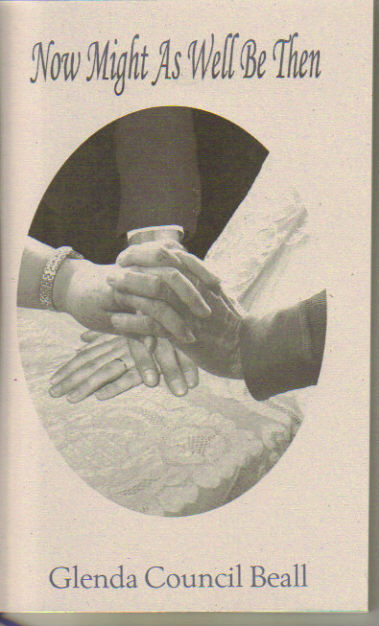
Glenda Council Beall's new chapbook, Now Might As Well Be Then, from Finishing Line Press (http://www.finishinglinepress.com/) deserves many readers. I was honored to write a blurb for it. Glenda has worked wonders for NETWEST as Program Director and deserves our thanks for supporting the literary arts in Western North Carolina.
Often those "supporters" are so busy making sure other writers find what they need to become better at the writer's craft that they don't have time for their own work. That's why I'm so pleased to honor Glenda as Poet of the Day. Here are a couple of my favorite poems from her new chapbook.


WOMAN IN THE MIRROR

What happened to seventeen,

when I rode my mare

free as the river flows,

jumped over downed trees

splashed through narrow streams?


What happened to twenty

when I danced in the moonlight,

my slender form dressed in a gown

white and shimmery as pearl?


What happened to thirty

when I rode my Yamaha

down fire roads, mountain trails,

long black hair flying free?


What happened to those days

I ask the woman in the mirror.

Gone, she says, all gone, unless

you remember it.


In The Dark


Lying in bed, my cheek against your shoulder,

I remember a night, long ago, on your boat.

I was afraid. I felt too much, too fast.

But love crept over us that summer

like silver fog, silent on the lake.

We were never again the same.


We stepped like children through that door that led

to long passages unknown, holding hands, wide-eyed, but brave.

Here I am years later, listening to your soft breath

and feeling your warm smooth skin.

In the dark, now might as well be then.

Wednesday, April 28, 2010

POET OF THE DAY: LEE SMITH

(Lee signs her new book for me.) Lee Smith probably wrote poetry back in her student--or childhood--days, and she may secretly write it now, but I think she also writes poetry in her novels and shorts stories, and I have shamelessly used those to rev up my own poems when I felt my poet's engine running down.
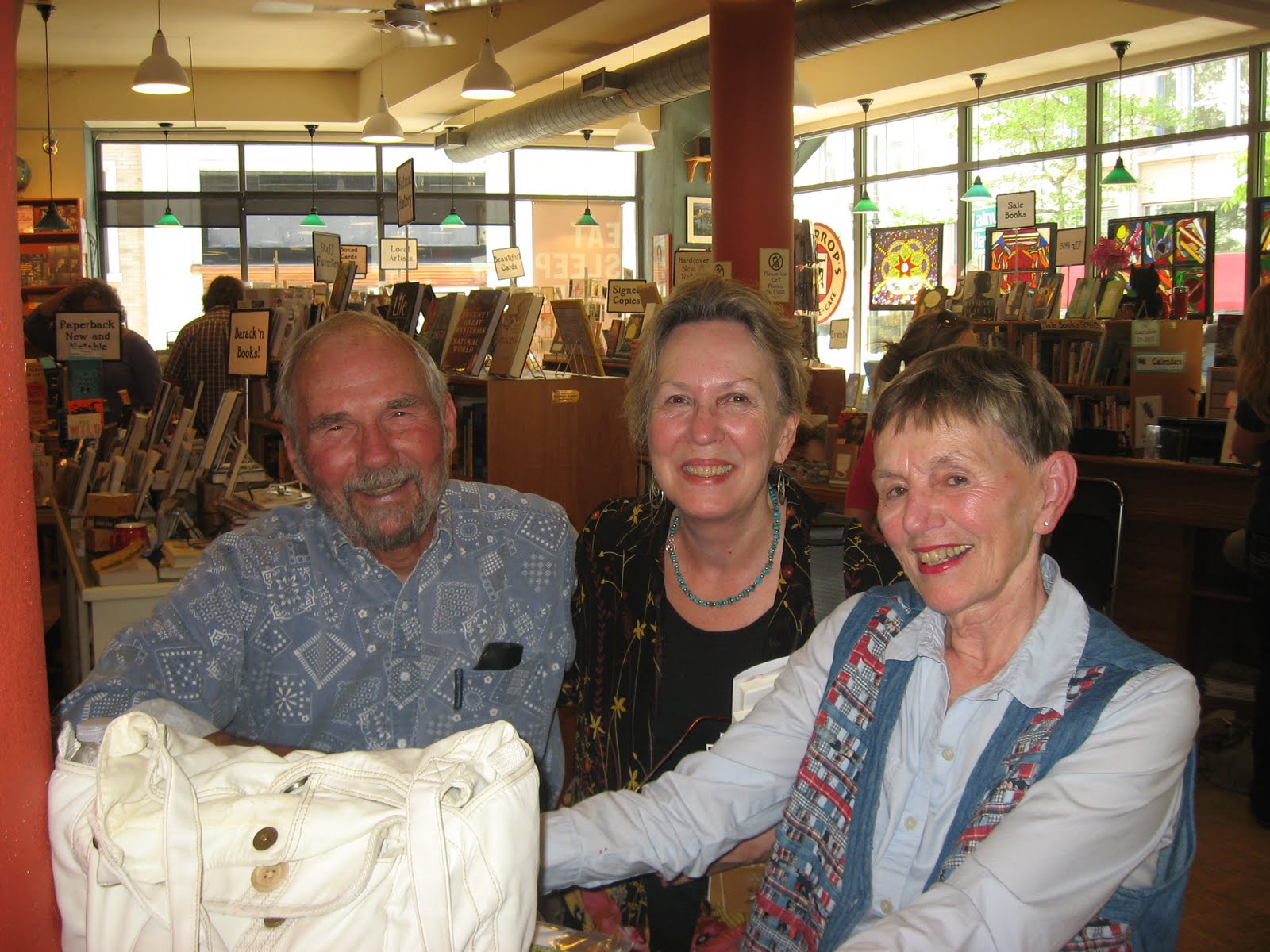
Lee came to Asheville on Sunday to read from her new book of stories, Mrs. Darcy and the Blue-Eyed Stranger: New and Selected Stories. There was standing room only at Malaprop's Bookstore. Afterward I had time to visit with Lee and the woman who has brought her work to life on the stage, Barbara Bates Smith. Barbara's wonderful husband and my brother joined us for a glass of wine at a downtown restaurant.
Go to Barbara's website to learn more about her one-woman shows. (Mugging it up with Lee at Malaprop's)
Here is the last paragraph from "The Southern Cross." Chanel, the narrator, (not her real name, of course!) has jumped off the yacht on which she's been cruising with Larry, the man she calls her fiance but who has never had any intention of leaving his wife, as she learns near story's end. She lands in the dinghy and heads for the tropical island nearby and a new life. "Going Native," she yells back to the astonished men on deck.
A part of me can't believe I'm acting this crazy, while another part of me is saying, "Go, Girl." A little breeze comes up and ruffles my hair. I practice deep breathing from aerobics and look all around. The water is smooth as glass. The whole damn sky is full of stars. It is just beautiful. All the stars are reflected in the water. Right overhead I see Orion and then I see his belt, as clear as can be. I'm headed for the island, sliding through the stars.

Monday, April 26, 2010

POET OF THE DAY: JULIA NUNNALLY DUNCAN

Julia Nunnally Duncan has been a friend for many years. Her work came to my attention when I was on the reading committee for the Appalachian Consortium Press and found her story collection Blue Ridge Shadows in my hands. I liked it so much that I contacted her after the selection process. We've been in touch ever since. Julia was born and raised in WNC. Her credits include five books: two short story collections (The Stone Carver; Blue Ridge Shadows); two novels: (When Day Is Done; Drops of the Night) and a poetry collection (An Endless Tapestry).

She has completed a second poetry collection At Dusk and continues to write and publish poems, stories, and personal essays. Her works often explore the lives of the unemployed, the socially outcast, the lonely. She lives in Marion, NC, with her husband Steve, a woodcarver, and their eleven-year-old daughter Annie. She studied creative writing at Warren Wilson College's MFA Program for Writers and teaches English at McDowell Technical Community College in Marion, NC.

English Leather Lime

The rectangular box was stored

in my parents’ dresser drawer,

kept perhaps to hold loose change

or sales receipts,

too small to be very useful

but well enough made

of light soft wood

to make my mother think

it too important to throw away.

I pulled it from the drawer

while looking for some high school memento

from my cheerleading days,

and opening the box and holding it

to my nose,

I thought I caught the smell:

a citrus scent evoked

by the illustration of a lime

on the green label:

English Leather Lime.

The cologne the box once housed

had belonged to my brother

forty years ago.

I recognized that scent

in 1969

when the handsome

seventeen-year-old boy—

star of a rival basketball team—

passed through my parents’ front door

on a November evening.

It was my first date,

and I was afraid

to sit alone in the living room with him,

so my mother stayed close by

in the kitchen

while he courted me.

On our second date, though,

I savored our closeness

as we sat in his car

at our town’s drive-in theater

and awaited the film Thunder Road.

The speakers crackled B.J. Thomas’s

Raindrops Keep Fallin’ on My Head,

and when rain suddenly began to fall outside,

we looked at each other and smiled.

When the movie started,

he scooted closer and

coyly rested his dark head

on my shoulder,

his lime cologne mingling with the remnants of my

Love’s Fresh Lemon Cleanser.

He might have kissed me in a moment,

but when he reached to turn the ignition key

for heat and windshield wipers,

the engine would not start.

After that, he rushed around,

some tool in hand,

tinkering for a minute under the hood

and then trying the ignition again.

His efforts were useless, though,

and as if to admit defeat

he finally called his father

and then mine—

a courageous move indeed

since he was supposed to have taken me

to our warm downtown theater

to see Kurt Russell starring in

The Computer Wore Tennis Shoes.

When my father did drive up

in our red Mustang

to rescue me,

I never heard goodbye

from the boy

who huddled beside his father,

their heads bowed under the car hood,

both of them soaked and shivering

in the December rain.

Lady in the Truck

Lady in the Chevrolet truck,

parked beside me at Wal-Mart,

I can tell by the way

your blonde head leans against your window pane

and your side presses into the passenger door

that you cannot get far enough away

from the driver.

I know by the angle of his head,

the way his dark tangle of hair

shakes when he shouts at you,

that his anger couldn’t wait

until he took you home.

What are you thinking

when you peer out of the grimy window?

Do you take to heart

this man’s hard words?

Do you hurt when his fingers squeeze your arm

to make you listen?

I can see by the way he looks straight ahead now,

tight lipped,

leaning to start the ignition,

that though his rage is not over,

he has spoken his mind.

I see by the way your head is lowered,

your hand covering your face,

that you do not want him

to spy your pain.

You are a young woman still,

and though I can’t discern your face,

I know it is a face

that another person could love.

Your mouth could smile at a lover’s whisper;

your eyes close at a caress.

Yet more so I know that

tonight when this man

pushes his body

close to yours

in your sweltering bed,

his voice calm,

cajoling you back,

you will look at him

and hope that his words

won’t be so cruel again,

that his love might be

worth your faith.

Friday, April 23, 2010

POET OF THE DAY: ISABEL ZUBER

My good friend Isabel Zuber is both poet and novelist. We met 30 years ago at a writers conference led by A.R. Ammons in Critz, Va. A native of Boone, NC, she has lived her adult life in Winston-Salem. Her first novel Salt was published by Picador, and her chapbooks of poems have been published by the NC Writers Network (Annual chapbook award) and Persephone Press. More of her work may be found in the archives of ncarts.org, as well as in several anthologies, the most recent being Southern Appalachian Poets (http://www.mcfarlandpub.com/) and Clothes Lines. The following poem is from her forthcoming full-length collection Red Lily (Press 53)
Nightward

A last enormous freedom
is to run into the dark,
barely enough day left
to see vague hydrangeas
massed along the drive and junipers up like spears
against the sky. Bound then in the dusk with all that
can be there light says is not.
Rush the yard on grass-lashed,
bug-bit legs, turn round
and round till stars collide
with spires, breaking the
huge dinning noise
of all those tiny voices. Such venture is less, or more,
than brave, for dew’s sweet
or bitter, and there’s always
the lighted doorway and
the sense that if one runs
far and hard enough
there are arms in the darkness also.

Monday, April 19, 2010

NANCY SIMPSON IS POET OF THE DAY

Nancy Simpson is POET OF THE DAY on my blog Here, Where I Am. Drop by and say hello to Nancy with a comment!


Nancy Simpson has been a good friend for many, many years. She lives in Hayesville, North Carolina, a far western location bordering Georgia, and has worked hard to build a literary community there. She received her MFA from the Warren Wilson program, studying with Heather McHugh. Her poetry has appeared widely across the country in some of the best literary magazines. Carolina Wren Press will be publishing her New and Selected Poems, titled Living Above the Frost Line.

Saturday, April 17, 2010

NC NATIVE WINS RUTH LILLY POETRY PRIZE

I first heard of Eleanor Ross Taylor when I was a student in UNC-Greensboro's MFA writing program. She was the wife of Peter Taylor, the Pulitzer Prize winning novelist and short-story writer and long-time teacher at the university. More intriguing, though, was the news that she was also a poet, considered one of the best by none other than Randall Jarrell. I met Ms. Taylor at several parties, where she was gracious but reserved. Then I read her poetry and found a poet whose voice was and still is completely her own.
Now comes the news that Eleanor Ross Taylor has been awarded the Ruth Lilly Poetry prize from The Poetry Foundation, perhaps the most prestigious award given to an American Poet. No poet deserves it more than Ms. Taylor. A native of North Carolina, alumna of UNC-Greensboro, she is also the aunt of Heather Ross Miller, who was born in and continues to live in North Carolina.
Here is one of her more recent poems. Follwing it is the press release for the Lilly Award.


The Diary

1

Too much like myself,

it listens critically.

Edits, though seldom rereads.

In the margins: here incoherent.

Like me, it mumbles.

The more I “Speak up, girl!”

the less it says outright,

wants in fact not to say.

2

Contrary to belief, the word diary

means undivulged; clues trail

the pages and the trail breaks off,

scent’s lost. Wandering is

the only way out of this place.

Yet the helpless subjugation

to the daily task,

the need for trysting-place,

love for the white-hot page

that drains the wound, seals it.

3

I know the heroines of the craft-

the small-town wife, the clear some,

cloudy some fretful refrain

in her doubtful second marriage;

Jane Carlyle’s war with crowing cocks.

To whom? To me. They write to me.

From pages hidden in the covered wagon,

“I said nothing, but I thought the more.”

(But in a letter home:

“We are at the mercy of a madman.”)

Missing, Fanny Kemble’s account

of the night she fled upriver.

4

How to confide the footsteps of a shroud

under your window in the night?

The denials, the costumed felons

lurk in your wakings, nervously

pressing mustaches over their teeth.

Why are those scuds of gulls

hanging over the swamp today?

I, splashing, choking, struggling,

sinking in self-sight-

Oh, that little straw!

(from Late Leisure)

Eleanor Ross Taylor Awarded 2010 Ruth Lilly Poetry Prize

Award recognizes lifetime accomplishment with $100,000 prize

CHICAGO — The Poetry Foundation is pleased to announce that poet Eleanor Ross Taylor has won the 2010 Ruth Lilly Poetry Prize.

Presented annually to a living U.S. poet whose lifetime accomplishments warrant extraordinary recognition, the Ruth Lilly Poetry Prize is one of the most prestigious awards given to American poets. At $100,000, it is also one of the nation’s largest literary prizes. Established in 1986, the prize is sponsored and administered by the Poetry Foundation, publisher of Poetry magazine. Over the last 25 years, the Lilly Prize has awarded more than $1,800,000. The prize will be presented at the Pegasus Awards ceremony at the Arts Club of Chicago on Tuesday, May 18.

In making the announcement, Christian Wiman, editor of Poetry magazine, cited the strong reserve in Taylor’s poems and praised their “sober and clear-eyed serenity” and authority.
“We live in a time when poetic styles seem to become more antic and frantic by the day, and Taylor’s voice has been muted from the start. Muted, not quiet,” said Wiman. “You can’t read these poems without feeling the pent-up energy in them, the focused, even frustrated compression, and then the occasional clear lyric fury. And yet you can’t read them without feeling, as well, a bracing sense of spiritual largesse and some great inner liberty.”
A portfolio of 10 of Taylor’s poems will be featured in the May issue of Poetry. In introducing the selection, Wiman writes:
The winner of this year’s Ruth Lilly Prize is Eleanor Ross Taylor. I suspect the name will be unfamiliar to a number of our readers, the work to even more. Until the excellent selected poems, Captive Voices, was published by LSU Press last year, virtually all of Taylor’s work was out of print. Her slow production (six books in 50 years), dislike of poetry readings (“It seems to me that it’s all for the person and not the poetry”), and unfashionable fidelity to narrative and clarity haven’t helped matters. And yet, as is so often the case, what’s been bad for the career has been good for the poems. With their intricately odd designs and careful, off-kilter music, their vital characters and volatile silences, the poems have a hard-won, homemade fatedness to them. You can feel their future.

Eleanor Ross Taylor has published six collections of poetry: Wilderness of Ladies (1960), Welcome Eumenides (1972), New and Selected Poems (1983), Days Going/Days Coming Back (1991), Late Leisure (1999), and Captive Voices: New and Selected Poems (2009).

A mother of two grown children and a grandmother, Taylor now resides in Charlottesville, Virginia. She has received the Poetry Society of America’s Shelley Memorial Prize (1997–98), a fellowship from the American Academy of Arts and Letters (1998), the Library of Virginia’s Literary Award for Poetry (2000), and the Aiken Taylor Award for Modern Poetry (2001). She was elected to the Fellowship of Southern Writers in 2009.

Previous recipients of the Ruth Lilly Poetry Prize are Adrienne Rich, Philip Levine, Anthony Hecht, Mona Van Duyn, Hayden Carruth, David Wagoner, John Ashbery, Charles Wright, Donald Hall, A.R. Ammons, Gerald Stern, William Matthews, W.S. Merwin, Maxine Kumin, Carl Dennis, Yusef Komunyakaa, Lisel Mueller, Linda Pastan, Kay Ryan, C.K. Williams, Richard Wilbur, Lucille Clifton, Gary Snyder, and Fanny Howe.